Hector V2 Humanoid
Motivation
Hector V2 was conceived as a reimagination of Hector V1, motivated by the need to move beyond locomotion-focused humanoid research toward integrated whole-body behaviors. While Hector V1 enabled systematic study of dynamic bipedal locomotion, its commercial low-level control stack constrained the number of actuators that could be reliably controlled, and its morphology limited behaviors that require coordinated use of the upper body, such as loco-manipulation. Hector V2 was therefore designed to remove these platform-level bottlenecks—supporting expanded actuation and adding articulated arms—so that research on whole-body control and arm–leg coordination can be conducted on a unified humanoid platform.
Mechanical Design
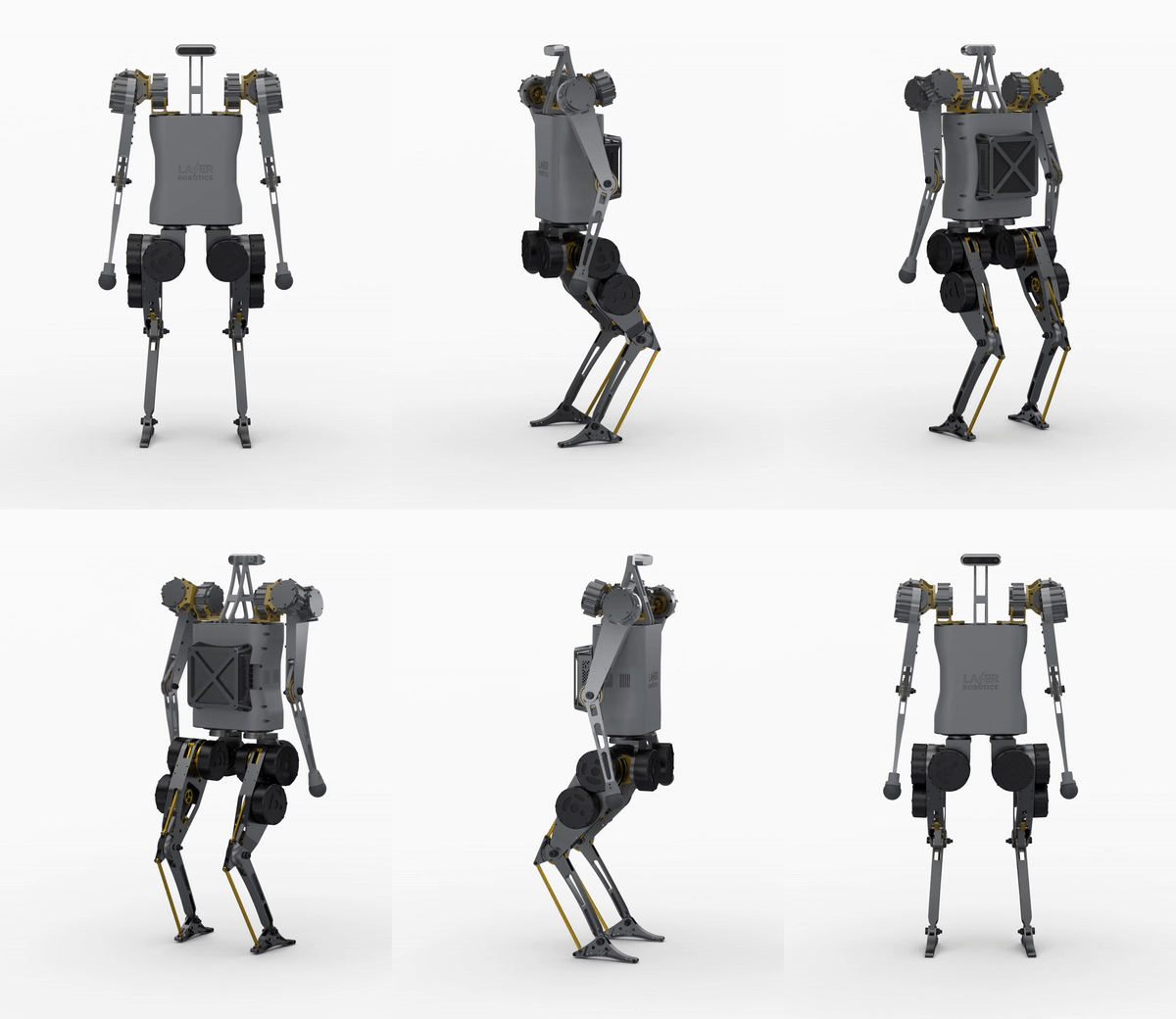
The overall hardware design philosophy of Hector V2 builds directly upon the lessons learned from the previous iteration, while addressing several key limitations observed in long-term use. Rather than pursuing a complete redesign, Hector V2 focuses on improving structural robustness, manufacturability, and system integration while preserving a proven kinematic and actuation layout.
One major change in Hector V2 is the redesign of the leg structure. In earlier versions, laser-cut leg components were used primarily to reduce cost and fabrication time. For Hector V2, these components were redesigned for CNC machining and refined through topology optimization. This approach allows the legs to maintain a lightweight structure while significantly improving stiffness, durability, and resistance to fatigue—critical factors for dynamic locomotion and repeated hardware testing.
The leg kinematic structure remains at five degrees of freedom per leg, consistent with the previous design. This choice preserves a well-understood control and planning framework while enabling sufficient flexibility for walking, balancing, and dynamic motions. The knee joint continues to employ a hybrid transmission system, which combines gearing and linkage mechanisms to amplify torque output without excessively increasing motor size or mass.
To expand the robot’s capability beyond locomotion, Hector V2 introduces a four-degree-of-freedom arm, enabling basic manipulation tasks and supporting research in loco-manipulation. To simplify dynamics and align with common control assumptions, all arm actuators are concentrated near the torso, reducing distal mass and improving controllability. The elbow joint is driven via a single-stage timing belt transmission, which offers a compact, lightweight solution while maintaining adequate torque and compliance.
The torso and body structure were also redesigned to better support system-level integration. Hector V2 accommodates a readily available drill battery as its primary power source, simplifying sourcing and replacement while providing sufficient energy density for extended operation. In addition, the body houses an in-house designed low-level control board and power distribution board, allowing tighter integration between hardware, firmware, and high-level control software.
Finally, Hector V2 is designed with flexible onboard computation in mind. A dedicated mounting interface on the back of the robot supports multiple compute options, including platforms such as the Intel NUC and NVIDIA Jetson Orin. To improve robustness in real-world operation, a metal protective cover shields the compute unit from potential impact during falls, ensuring both mechanical protection and continued system reliability.
Low-level Control Board Hardware and Firmware
The low-level control board serves as the motor cortex of Hector V2, acting as the interface between high-level motion planning and the robot’s actuators. Commands generated by the high-level control software are transmitted to this board, where they are translated into motor-specific communication protocols and dispatched to each joint actuator in real time.
Hector V2 integrates two types of joint actuators with different communication interfaces. Unitree A1 joint actuators communicate over an RS485 bus, while Robstride 01 joint actuators use a CAN bus. To support this heterogeneous actuation setup, the low-level control board is equipped with dedicated transceivers for both RS485 and CAN communication, allowing seamless and synchronized control of all joints within a unified framework.
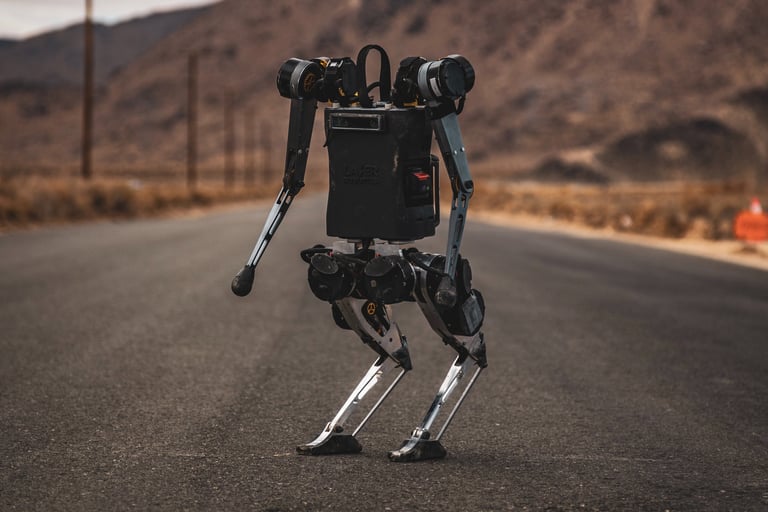
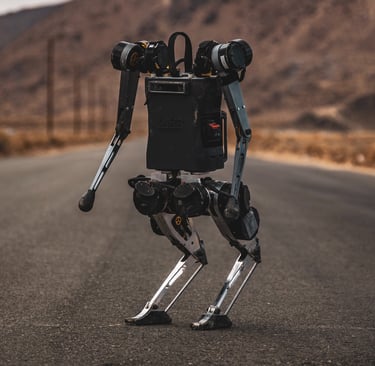
At the core of the control board is a Teensy 4.1 microcontroller, which runs a real-time operating system (RTOS). The RTOS ensures deterministic timing and reliable message scheduling, enabling commands and feedback to be exchanged with each motor at high frequency and with low latency. This real-time capability is essential for stable whole-body control, especially during dynamic motions such as walking and manipulation.
In addition to motor communication, the low-level control board integrates an onboard inertial measurement unit (IMU). The IMU provides high-rate orientation and acceleration data that can be used for state estimation, feedback control, and safety monitoring. By colocating sensing, communication, and real-time computation on a single board, Hector V2 achieves a tightly integrated low-level control architecture that supports both robustness and extensibility.
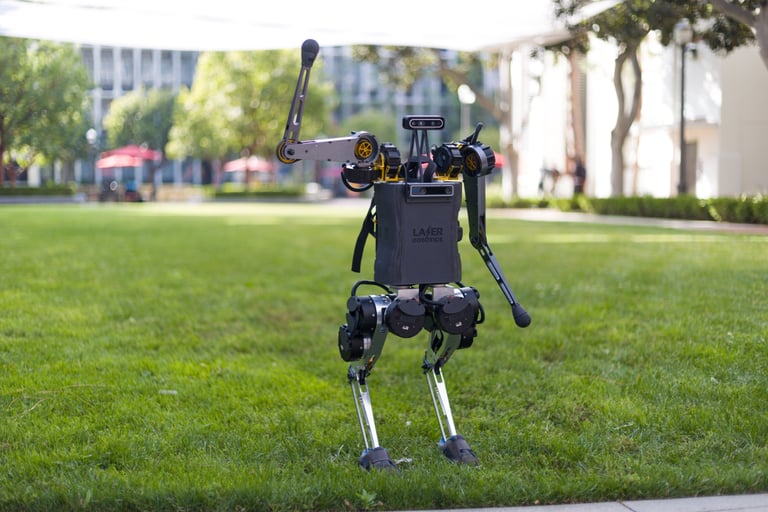
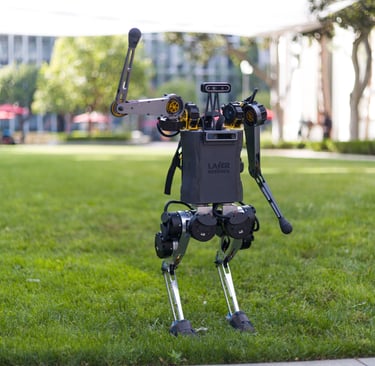
Robots in-motion


Contact
Reach out for internships or collaborations
Phone
junchaom@usc.edu
+1-507-269-9963
© 2025. All rights reserved.